Core software for lenders, banks and treasuries, from a small company that has been at it since 1995.
TVM is a small, specialised software company. We build the systems that keep the accounts behind a loan book, a deposit book or a structured-finance book, and we've been doing it long enough to have got it wrong a couple of times first.
One of them has run the structured-finance book of one of the world's safest banks since 2001.
LedgerTM is our latest platform, and the third generation of the same design.
It takes an engine design with twenty-five years in production and rebuilds it with modern engineering and AI. What you license is the platform, a set of templates for the business you're in, the source code, and the AI skills we use to build it ourselves. A template sets up a working business with its products, its chart of accounts and its posting rules, a country layer adds the currency, rails and legislation of the place you operate in, and from there it's configured to your own book, which is a much shorter road than building one from nothing.
Templates for six lines of business.
Corporate banking
A corporate bank, an overlay that puts virtual accounts, sweeps and pooling over the core you already have, an in-house bank for a group treasury, and a client money operator.
Corporate banking →Lending
A personal lender and a microlender, with vehicle finance and mortgage bonds in the retail bank. Instalment collection, arrears, promises to pay and provisioning come with them on day one.
Lenders →Retail banking
Call, fixed and notice deposits beside personal loans, mortgages and vehicle finance, with the credit limits, collateral, collections and tax certificates a retail book needs around them.
The templates →Cards
A card issuer and a merchant acquirer. Statements, disputes and chargebacks on the one side, and merchant agreements, sponsor banks and settlement in several currencies on the other.
Cards in five days →Investments
An investment house taking call, fixed and notice deposits from people and businesses, with the withholding tax and the certificates that go with them.
Investment houses →Structured finance
Loans given, funding taken, swaps and fees of every shape, twenty-five account types in all, grouped into structures and booked per legal entity. It’s the book a major European bank has run on this engine since 2001.
The templates →If your business isn't quite one of these, we start from the nearest one.
That's how most of these templates were made. The microlender, the personal lender, the investment house, the card issuer and the merchant acquirer all began as the retail bank, with some things switched off and others added. The corporate overlay, the in-house bank and the client money operator came out of the corporate bank the same way. So a new line of business is a template cut from an established one, on the same platform, and it inherits everything the parent already had working. The templates →
A template knows the business, and a country layer knows where you're doing it.
The country layer sits over any template and carries the things that change at the border: the currency, the calendar, the payment rails, the identification and address rules, the tax and the legislation. We have layers for South Africa, the United Kingdom, Canada and the Netherlands, and they aren't all equally deep. South Africa has its credit, tax and anti-money-laundering law in it, and the UK has its rails and its tax but no regulatory regime yet. The United States is next. The corporate banking templates were designed with that market in mind and the ACH rail is built, but the country layer itself isn't yet.
So we probably don't have yours, and we'd rather say so now than in the third meeting. The good news is that a country is a small job next to a core system. The UK's calendar, identification, addresses and local rules came as a folder of configuration with no code change. The payment rails are the bigger piece, because each one has its own file formats to build, and that's the kind of work the AI and the skills handle well. How the UK layer went →
Not everyone wants to own a core system, and you don't have to.
Take it in-house
If you have a technology team, you license the platform with its source and the AI skills we build it with, and your own people configure and extend it. This suits a bank or a larger lender that wants the code and the roadmap in its own hands.
Licensing →Have it built for you
If you'd rather run a lending business than a development shop, and you already have an implementation partner you trust with your systems, bring them along. We work with them, and they take a template, add your country layer, configure it to your book, and host and support it, so you get a working system from people who already know your business. If you don't have a partner in mind, talk to us anyway and we'll work out the best way to get you there.
If you're that partner →It's the same platform and the same templates either way.
If you're here on behalf of a client, or several of them, this part is for you.
Over the years we've sat down with some very good banking and payments consultancies to talk about partnering, and it usually stalled on the same thing. Their people worked on a different stack, and taking on somebody else's engine in an unfamiliar language was a big ask. That problem has largely gone away, because the AI skills and the engineering rules ship with the source, so a partner who knows the business can describe a change in business terms and have it built inside the same guard rails we use.
Start from a template
You take the nearest template, add the country layer for your market and configure it to the client's book. You know the local rules far better than we do, and the layer you write for your first client is there for your second.
One installation, many clients
Each of your clients is a tenant in your one installation and not a separate install, so serving your twentieth costs you close to nothing.
Resell it, or make it yours
As a reseller you keep the relationship and share in the income, and the licence sits between us and the customer. Under a white-label licence you hold the source, set your own price, and host and support it yourself.
Source, skills and an AI-enabled dev environment
The licence includes the whole engine and the skills that maintain it, so your domain experts can extend it the way we do, with the engineering discipline already built in. As far as we know, nobody else in this market ships the core.
How it works →Accounts grouped into structures and legal entities
A loan, its funding, the swap that hedges it and the fees around it, kept as one structure and accounted for in the legal entity that owns it. Most cores still cannot do this.
The model →Multi-currency and multi-calendar as the engine
Every account carries its own currency and calendars, so revaluation, business-day conventions and irregular schedules are part of the engine rather than a module you buy later.
The primitives →Change it, see it, sign it
A workbench where you try a change, see the before-and-after and the forecast with it applied, and then keep it or throw it away. A set of changes goes off as one authorisation to the approvers your rules name, and they sign the list itself.
Studio →A day-end you can run forward and replay
Forecast an account to maturity with the same code that runs tonight's day-end, back-date a correction and watch the ledger put itself right, and trace every figure back to the events that made it.
Event sourcing →Until now it has been build or buy.
If you've ever waited months for a vendor to put your change on their roadmap, and then paid for the privilege, you'll know the buy side. A handful of vendors supply core banking systems, they're expensive, and what you get is a runtime you can't read. Building your own is the other road, and it's a hard one. AI has made the first month of that road easy, but the fifth year is no easier than it ever was. Good luck if you're going to try and vibe-code a banking system. It won't end well.
There's a third option, which is to start from one that already works.
LedgerTM is that starting point: an engine with twenty-five years in production servicing loans, deposits and structured finance, described in ten primitives that fit a treasury's intercompany book as well as a bank's. It comes with its source, the architecture and decision records behind it, and the AI skills we use to maintain it. Two demonstration books run on it today. Your product and finance people adapt it to your book while the AI does the engineering, and the code, the rules and the roadmap end up yours.
The person who changes it is the person who knows the business. They say what they want in business terms, the AI writes the change inside the engineering rules, the build refuses anything that breaks one, and your approvers sign it before it goes live. It isn't a bank in a box, and your IT team still runs the platform, they just stop being the queue every change waits in. We're pre-launch, and everything on this page runs in a demonstration tenant today. We'd rather you saw that than a brochure.
So don't only ask whether it does everything your book needs today. Ask how long it would take to add what it doesn't, and how good it would be when it's done.
To give you an idea of what this means in practice, we documented what it took us to add card issuing and acquiring in five days, in a business domain we know but aren't experts in. It shows how you can couple a proven software base with AI that fills the gaps in your business knowledge and brings in the industry's best practice, and nobody wrote a line of code by hand. We take you through it step by step, so you can see how you'd do it yourself. Cards in five days, from the first prompt, mistakes and all →
Why not build from scratch →A clean interface is a mark of a clean model underneath.
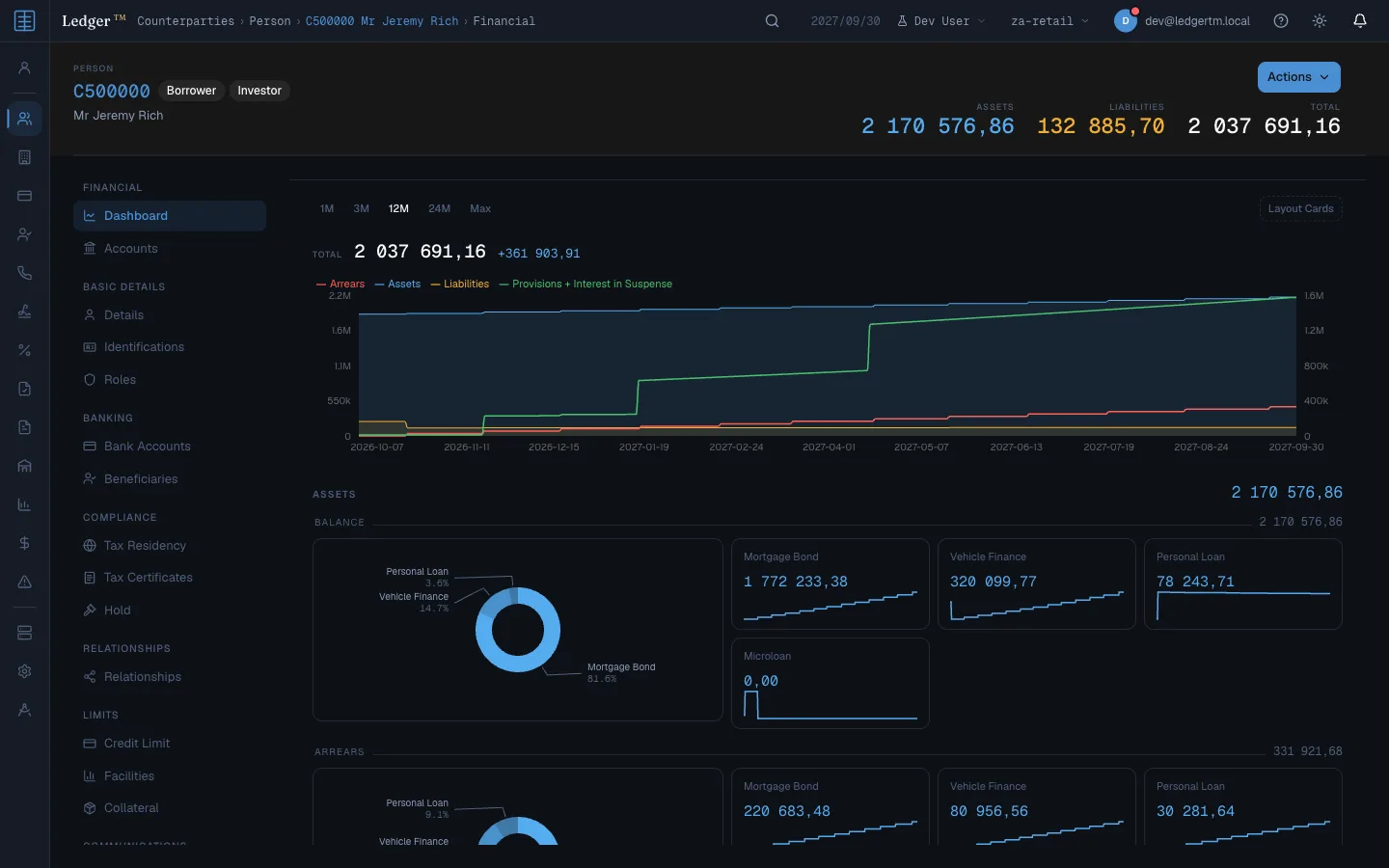
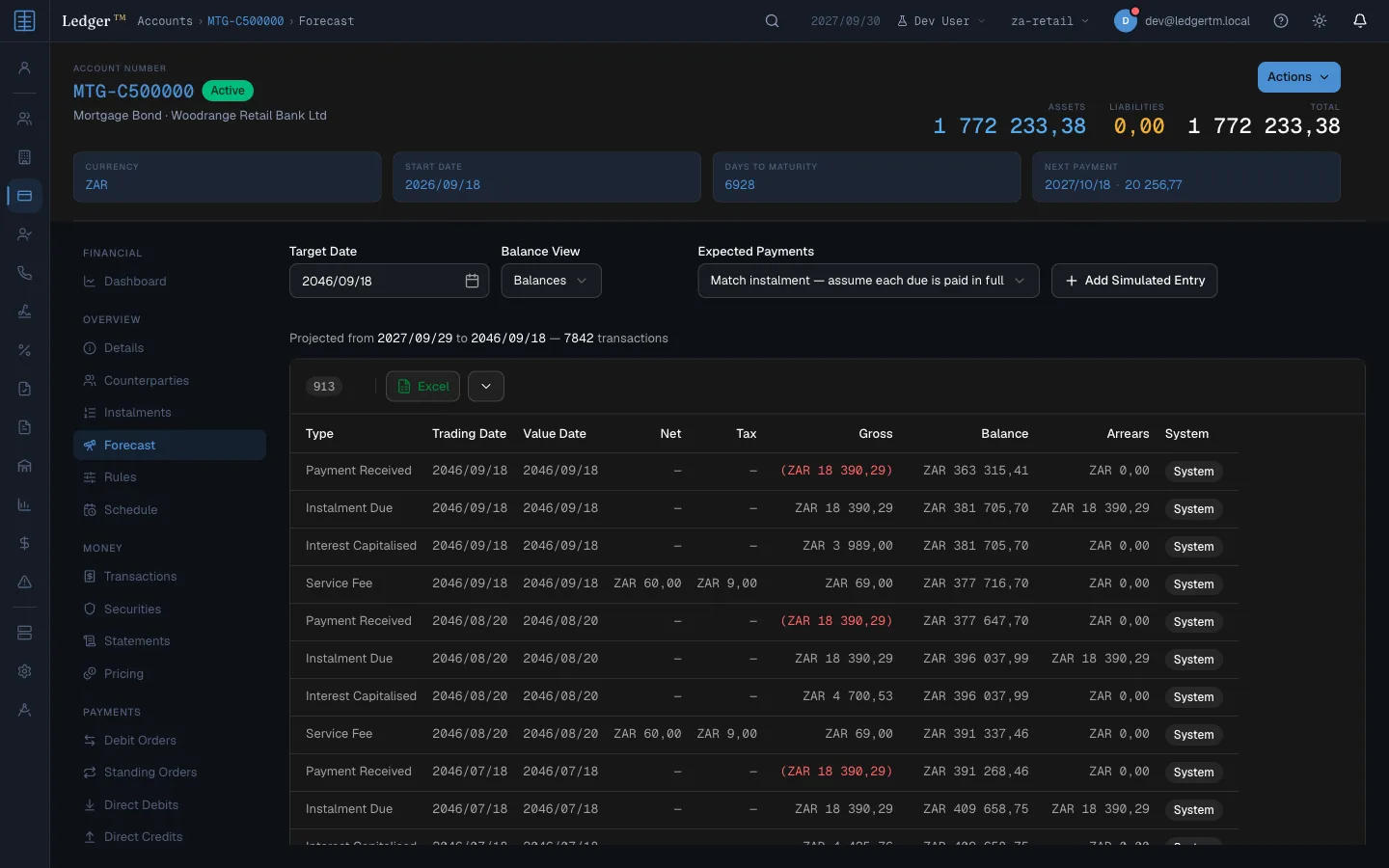
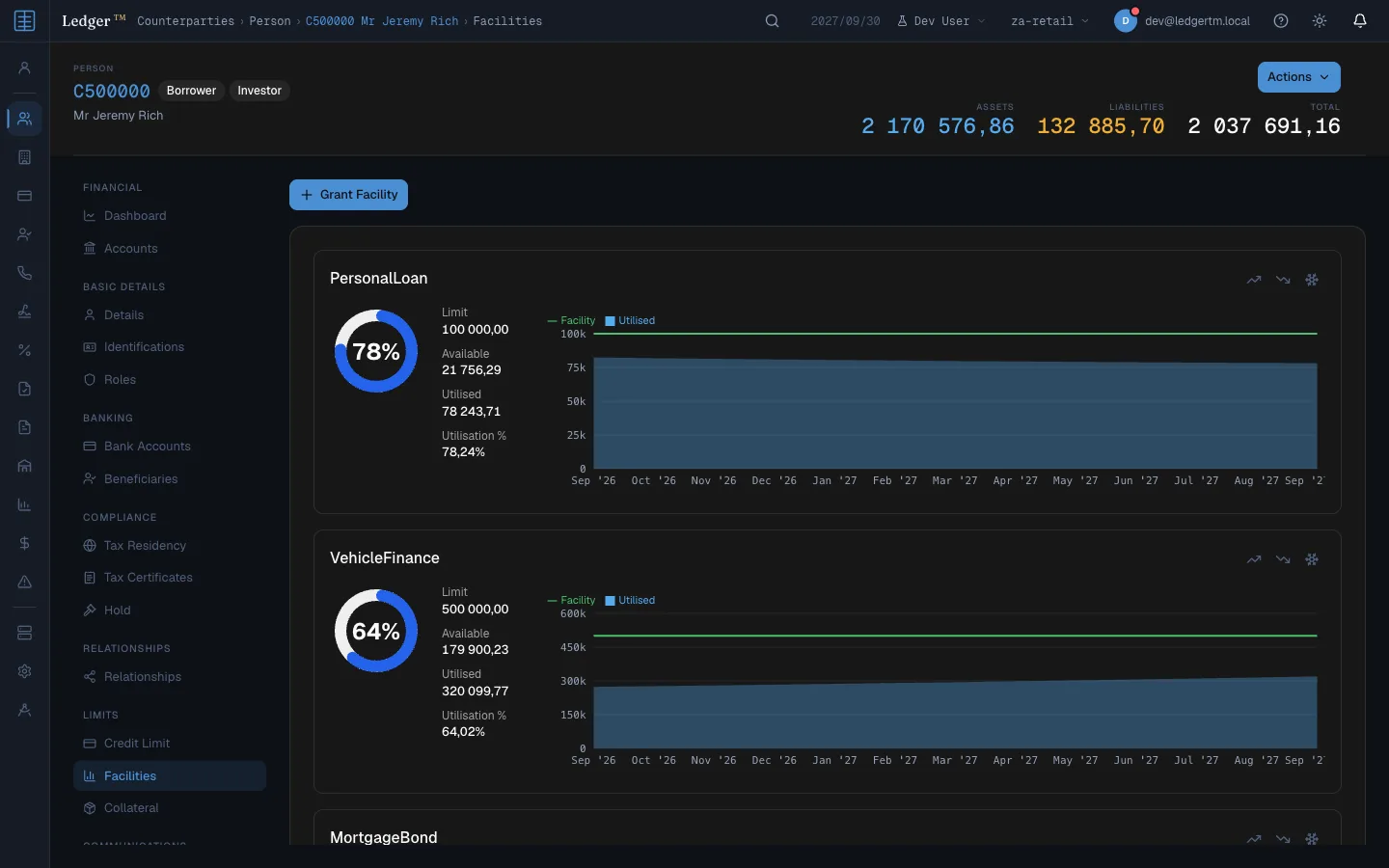
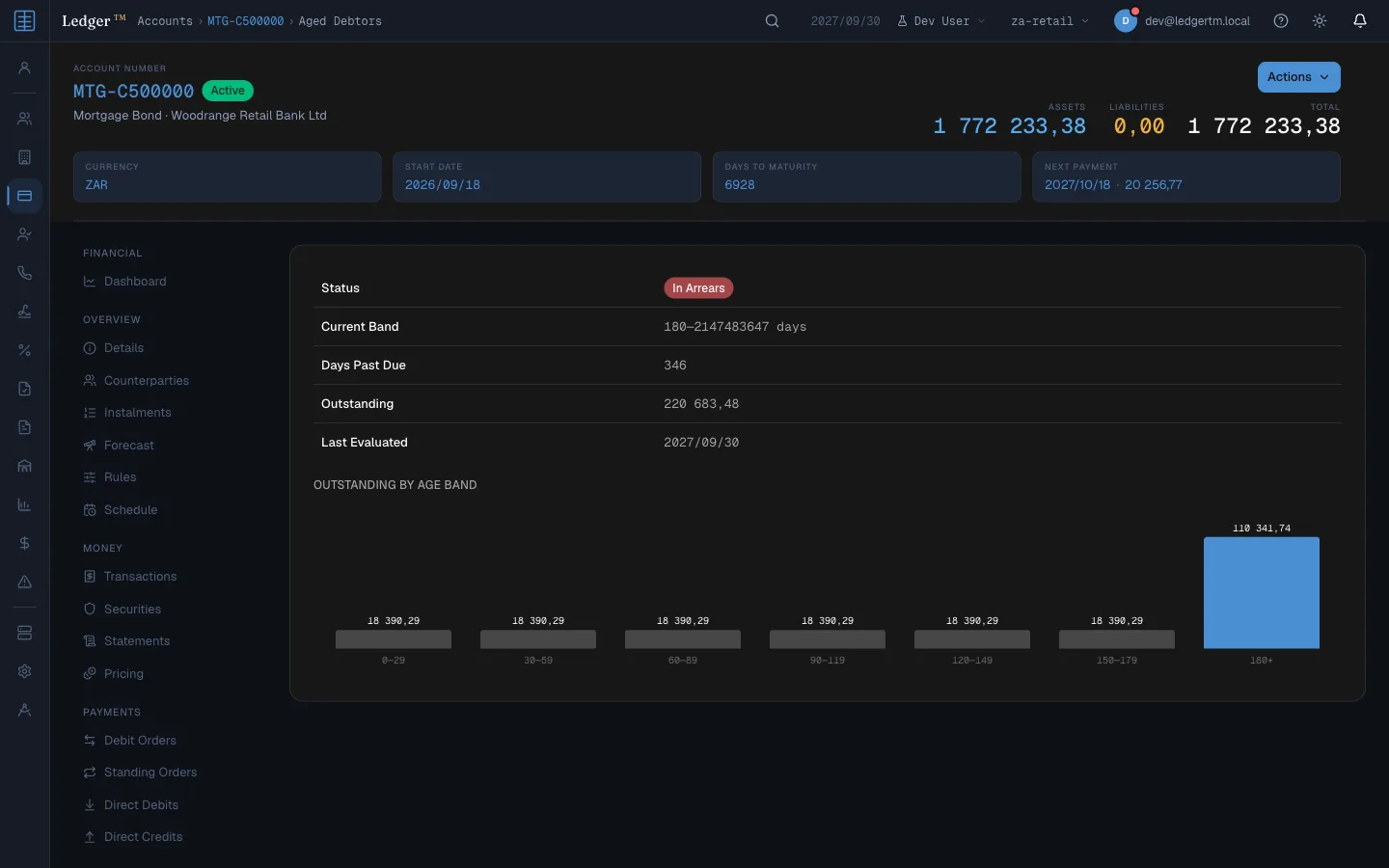
The core is built, and we're refining the design before launch.
Two demonstration books run on it today, a structured-finance book and a retail bank. Between now and launch we're adding business templates, running a full security audit, testing scale, and carrying out the first production migration, which moves the structured-finance book of one of the world's safest banks from the previous generation of this engine onto LedgerTM.
A production release goes on sale in the first quarter of 2027, and you can evaluate it now.
Early adopters. Bring us a product or a book and we'll configure a template to it, load your sample data, and show it running on your rules in a tenant of your own, with no fee and no commitment. You find out whether it fits before you spend anything, and we get the design tested against a real requirement, which right now is worth more to us than a fee.
jrich@tvm.co.zaTVM Software was founded in 1995 in South Africa by a domain expert and a technologist. The same engine has been through three generations since, and has run at one of the world's safest banks since 2001.
The whole story →